Choosing a PCB assembly partner in China is one of the highest-stakes procurement decisions a hardware company makes. Get it right, and you gain a manufacturing relationship that scales from prototype to production with consistent quality and predictable costs. Get it wrong, and you're managing quality escapes, missed delivery dates, and component sourcing problems from 12 time zones away.
China's PCB assembly industry spans roughly 3,000 active manufacturers, from two-person shops operating a single pick-and-place machine in a Shenzhen apartment to ISO 13485-certified facilities serving medical device OEMs. The variance in capability is enormous, and price is a poor proxy for quality — some of the cheapest quotes come from shops with genuine capability, and some of the most expensive come from trading companies that own no equipment at all.
This guide provides a structured evaluation framework based on what our international clients at Uppcba consistently ask about during factory audits and qualification calls. The 10 criteria below are scorable — you can assign points and compare suppliers on a consistent basis rather than relying on sales brochures and price sheets.
1. Certifications: Do They Match Your Product's Requirements?
Certifications are the minimum bar — not a differentiator. A manufacturer without the certifications your product requires should be eliminated immediately, regardless of price. But certifications alone don't guarantee quality; they guarantee that a process exists and was in compliance on the day of the audit.
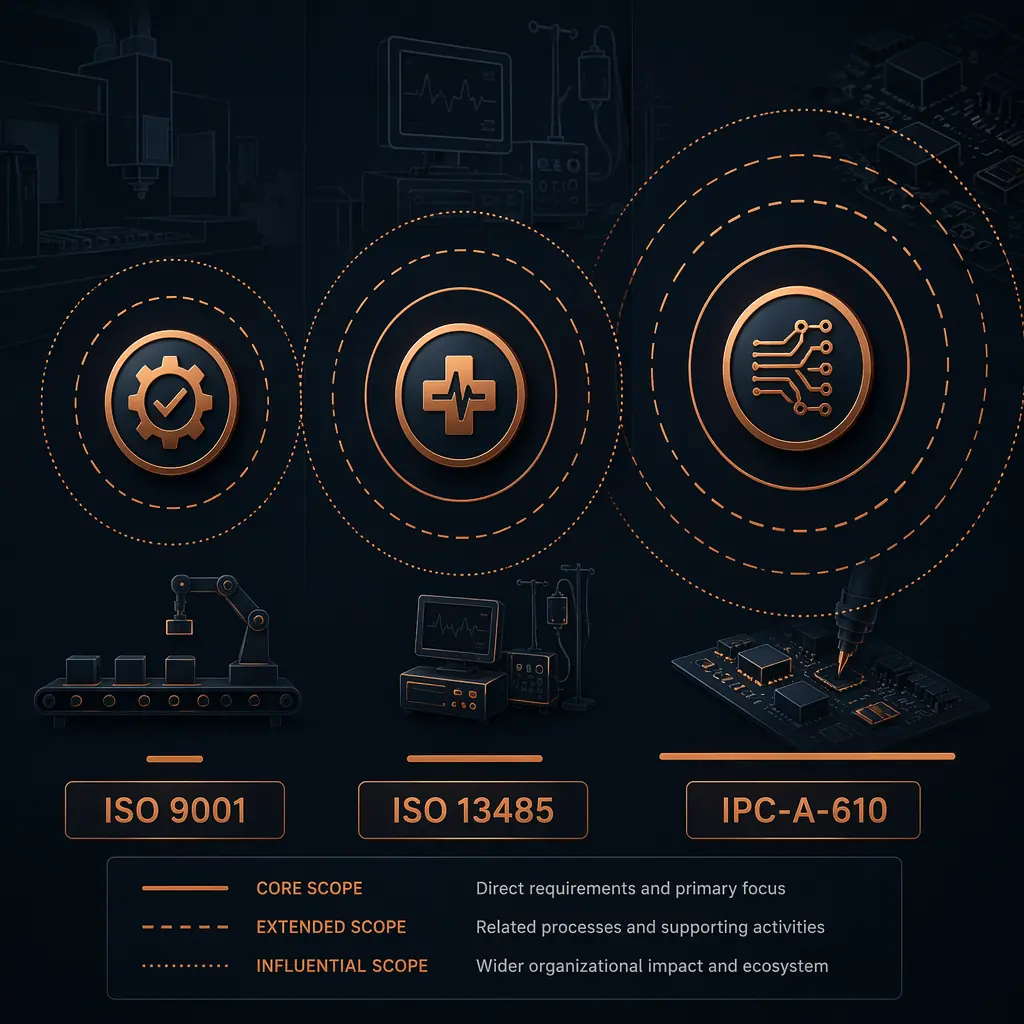
ISO 9001 is the baseline for any professional assembly operation. It certifies that the manufacturer has a documented quality management system — process control, document control, corrective action procedures, management review. Without it, you're betting that undocumented tribal knowledge produces consistent results. It almost never does at scale.
ISO 13485 is the medical device-specific extension of ISO 9001, adding requirements for risk management, design control traceability, and sterilization validation where applicable. If your product is a medical device or a subsystem that feeds into one, ISO 13485 is effectively mandatory — not for regulatory submission alone, but because the process discipline it enforces (lot traceability, validated cleaning processes, stricter change control) directly reduces field failure risk. Uppcba maintains ISO 13485 specifically because our medical device clients cannot accept the process variability that ISO 9001 alone permits.
IPC-A-610 is the workmanship standard for electronic assemblies. Class 2 covers "dedicated service" products where extended life is desired but not critical — think consumer electronics, industrial controls, telecom equipment. Class 3 covers "high performance" products where downtime cannot be tolerated — medical devices, aerospace, automotive safety systems. The jump from Class 2 to Class 3 is more than tighter acceptance criteria; it requires the manufacturer to maintain process capability data (Cpk) on critical processes and demonstrate that the process consistently produces Class 3 results, not just that inspectors accept Class 3 workmanship on individual boards. For a deeper dive, see our guide on IPC Class 2 vs Class 3 acceptance criteria.
Verification tip: Ask for a copy of the certification body audit report, not just the certificate. The audit report shows non-conformances — every manufacturer has them — and what really matters is whether non-conformances are minor (documentation gaps) or major (systemic process failures) and how quickly they were closed. A manufacturer with 3 minor NCs closed in 30 days is stronger than one with zero observed NCs and an auditor who spent 4 hours on site.
2. Equipment: What's Actually on the Production Floor?
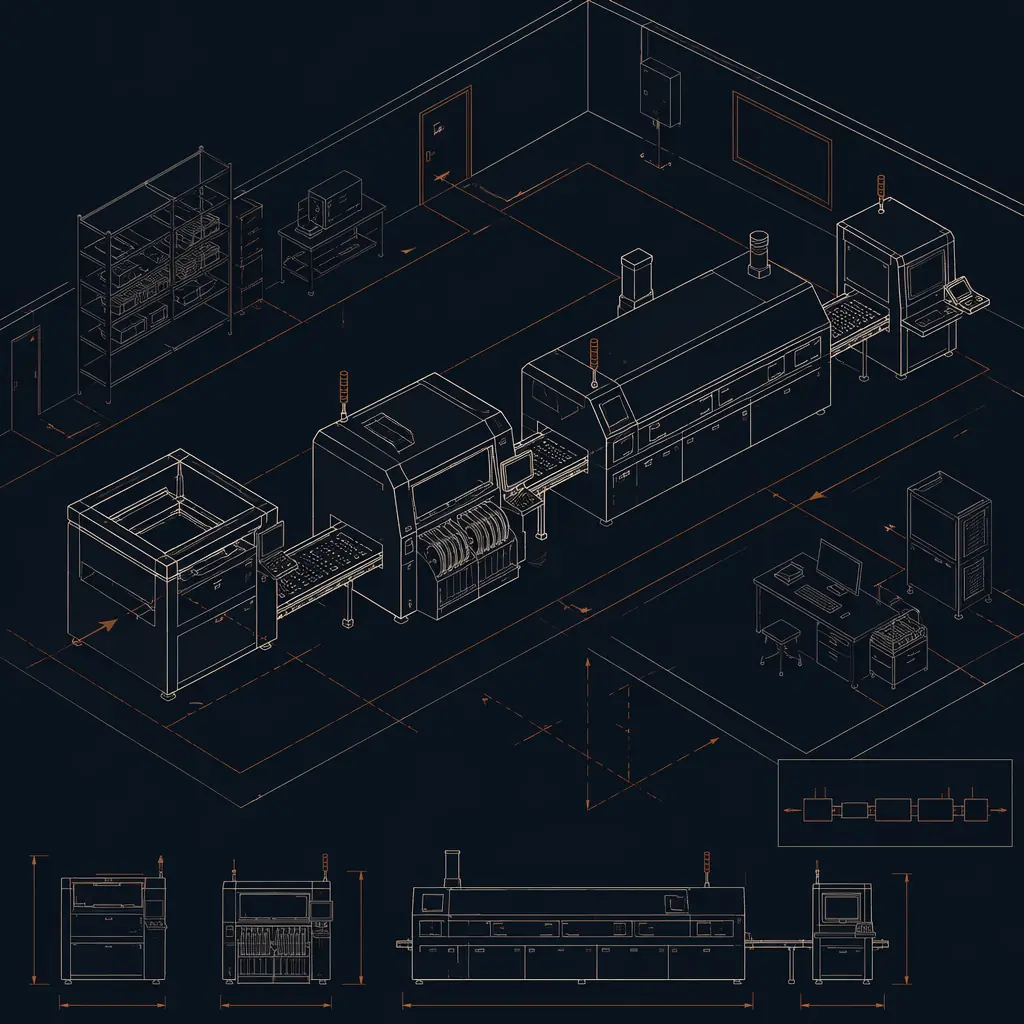
Equipment capability determines what the manufacturer can build, not just what they say they can build. A manufacturer claiming 0201 component capability but running a 2012-vintage placement machine is either being dishonest or running at the absolute edge of their machine's specification — neither is acceptable.
Pick-and-place machines: The key spec is placement speed and minimum component size. A modern line (Yamaha YSM20R, ASM SIPLACE, Fuji NXT III) places 40,000–80,000 CPH and handles 0201 (0.6×0.3 mm) passives and 0.3 mm pitch BGAs. Older machines (pre-2018 models or entry-level Chinese brands) may top out at 0402 and 0.5 mm pitch. If your design includes fine-pitch ICs or 0201 passives, verify the machine model, not just the spec sheet — the model tells you the year, and the year tells you the real capability floor.
Reflow ovens: Zone count matters. A 8–10 zone oven provides the thermal profile control needed for lead-free soldering of dense, mixed-technology boards. A 4–6 zone oven works for simple single-sided SMT but cannot maintain the ramp-soak-reflow profile within ±2°C across a complex board with varied thermal mass. Uppcba's 10-zone reflow ovens maintain ±1.5°C across all zones, which is the difference between consistent wetting and intermittent cold joints on boards with large BGA packages next to small passives.
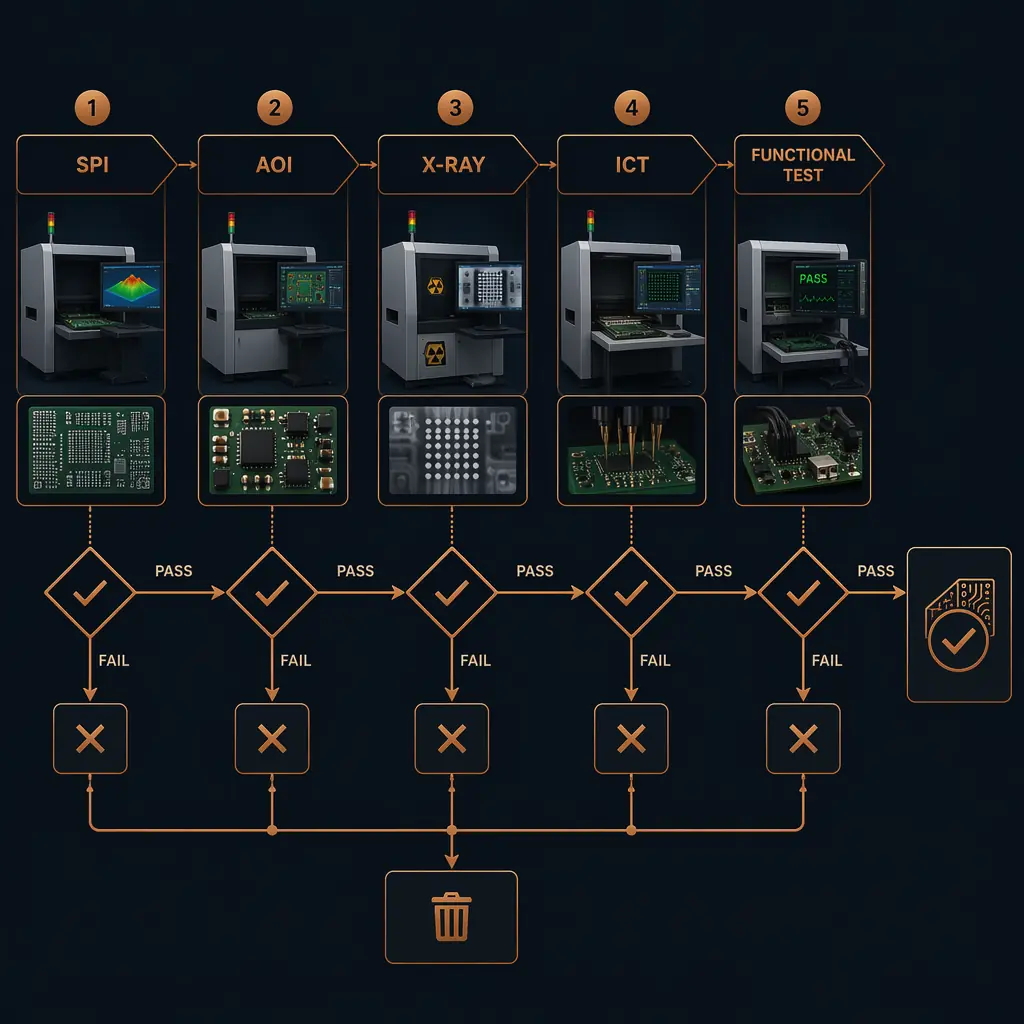
Inspection equipment: AOI (automated optical inspection) should be inline — meaning it inspects boards immediately after reflow, before they leave the SMT line. Offline AOI (boards are batched and inspected later) means defects are discovered after an entire batch has been produced, making root cause identification much harder. For BGA and QFN packages, X-ray inspection is non-negotiable — optical methods cannot see solder joints under the package. The cost of skipping X-ray inspection is measured in field failures, not inspection labor saved.
3. Engineering Support: DFM Review and NPI Capability
The quality of the engineering team is harder to evaluate than equipment — you can't point a camera at it — but it has more impact on your program's success than any single piece of hardware. A strong engineering team catches design issues before they reach production. A weak one builds whatever you send them and ships the results, functional or not.
DFM (Design for Manufacturability) review should be included in the quoting process — not offered as an add-on service. When you submit Gerber files and a BOM for quoting, the manufacturer's engineering team should review the design for assembly-specific issues: component spacing below minimum pitch, insufficient solder mask dams between fine-pitch pads, thermal relief patterns that won't reflow properly in production, components placed too close to board edges for panelization, and polarity markings that are ambiguous or missing. Uppcba's standard DFM review returns a marked-up report within 24 hours of RFQ submission, typically identifying 8–15 issues per new design — most of which the client's PCB designer was unaware of because PCB layout tools don't flag assembly-specific DFM rules.
NPI (New Product Introduction) capability matters when you're moving from prototype to production. A manufacturer with a structured NPI process will run a first-article build (typically 5–10 boards), document every process parameter (stencil design, paste type, placement program, reflow profile), capture AOI and X-ray data on every board, and produce an NPI report that becomes the process baseline for production runs. Without this, every production run starts from scratch — and process drift between runs is inevitable. For more on preparing your design for assembly, see our DFM preparation guide.
4. Component Sourcing: Authorized Distribution vs. Open Market
Component sourcing is where the largest capability gap exists between manufacturers — and the gap is invisible from a website or sales call. Every manufacturer will say they "source from authorized distributors." The question is: which ones, for what percentage of spend, and what happens when a part isn't available through authorized channels?
A credible manufacturer should be able to name their top 5 authorized distributors and show you a spend report. Uppcba's primary authorized channels include Digi-Key, Mouser, Arrow, Avnet, and LCSC for commodity passives — covering roughly 85% of component spend. The remaining 15% flows through verified secondary-market partners, and every IC above $5.00 unit cost sourced through secondary channels goes through X-ray comparison against a known-good reference before entering production.
Counterfeit detection is the capability you're actually paying for in component sourcing. The counterfeit IC problem in electronics manufacturing is estimated at $75 billion annually by the ERAI, and Shenzhen's component market — while incredibly useful for supply assurance — is also where counterfeit components are most likely to appear. A manufacturer should have a documented incoming inspection procedure for ICs that includes, at minimum: visual inspection at 40× magnification for remarking evidence, X-ray comparison of internal lead frame structure against a known-good reference, and acetone swab testing for blacktopping (a common counterfeit technique where the original marking is painted over and re-marked).
5. Quality Systems: Beyond the Inspection Station
Quality is not inspection — inspection finds defects after they happen. Quality is a system that prevents defects from happening in the first place. When evaluating a manufacturer, look for evidence of the system, not just the inspection equipment list.
First-article inspection (FAI) should be performed on the first board off the line for every production run, not just new product introductions. The FAI checks every component placement against the BOM and placement file, verifies polarity on every polarized component, and measures key dimensions. At Uppcba, FAI is a documented gate — production does not continue until the FAI is signed off by both the production engineer and the quality engineer.
Statistical process control (SPC) should be in place for critical processes: solder paste print thickness (measured by SPI — solder paste inspection), reflow profile temperatures at multiple thermocouple positions, and placement accuracy on fine-pitch components. SPC data tells you whether the process is stable (in control) or drifting toward the specification limit. A manufacturer who runs SPC and shares the control charts with you is demonstrating confidence in their process. One who doesn't — or who claims SPC is unnecessary for your volume — is telling you they manage quality by inspection and hope.
Traceability from component reel to board serial number is increasingly a hard requirement, not a nice-to-have. For medical devices (FDA 21 CFR Part 820), automotive (IATF 16949), and aerospace (AS9100), full lot traceability is mandated by regulation. Even for industrial and consumer products without regulatory requirements, traceability is what enables a targeted recall instead of a blanket recall when a component lot problem is discovered. Ask the manufacturer to walk you through their traceability system: how do they track which reel of capacitors went onto which board serial number? If the answer is "we track by date code," that's batch-level traceability, not board-level — and it means a capacitor lot problem triggers a recall of everything built that day, not just the affected boards.
6. Production Flexibility: Can They Handle Your Volume Profile?
Most procurement managers evaluate manufacturers at their current volume. But the manufacturer that's perfect for 500 units per month may be completely wrong for 5,000 — and vice versa. A high-volume factory optimized for 50,000-unit runs will treat your 500-unit order as a nuisance that doesn't cover the line changeover cost. A prototype shop running manual placement may deliver your first 50 boards beautifully and collapse completely when you scale to 500.
Look for a manufacturer whose sweet spot matches your projected volume range — not just your current volume. Uppcba's model is built for the prototype-to-mid-volume range: 5 to 5,000 units per run. Below 5 units, a dedicated prototype shop is more cost-effective. Above 5,000, a high-volume factory with dedicated lines will have lower unit cost — but you lose the engineering continuity of working with the same team that built your prototypes and knows your design history.
Process coverage is the other dimension of flexibility. Does the manufacturer do SMT only, or can they handle through-hole, mixed-technology assembly, and box-build integration? Every handoff between manufacturers — SMT at one shop, through-hole at another, final assembly at a third — adds logistics cost, quality risk, and schedule uncertainty. A single-roof operation eliminates these handoff costs. Verify this claim during a site visit: walk the floor and confirm that SMT, DIP, and box-build areas are all under the same roof, not subcontracted to separate facilities.
7. Communication and Project Management
Language capability and communication structure matter more than most buyers realize — until there's a quality issue at 10 PM in your time zone and you need an answer before your morning production meeting. Evaluate these specific communication factors:
Engineering English proficiency is different from sales English. The sales contact who speaks fluent English on the discovery call may not be the person reading your Gerber files and BOM. Ask to speak directly with the process engineer assigned to your program — in English — and discuss a technical detail from your design. If the conversation requires a translator, that translator becomes a permanent dependency in every technical discussion for the life of your program.
Single point of contact for program management. You should have one project manager who coordinates scheduling, engineering feedback, quality reporting, and logistics. If the manufacturer assigns you separate contacts for quoting, engineering, production scheduling, and shipping, you become the project manager — and you're managing a Chinese factory from overseas using email, which is a recipe for missed details and slow response.
8. The Site Visit: What to Look For
A site visit reveals more in 2 hours than 20 email exchanges. You don't need to be a manufacturing engineer to evaluate what matters. Look for these signals that cut through the sales presentation:
ESD protection is the first thing to check. Is everyone on the production floor wearing ESD smocks and heel straps? Are floors ESD-safe (conductive tile or epoxy, not standard ceramic)? Are component storage areas humidity-controlled? ESD damage is cumulative and invisible — a component damaged by ESD during handling may pass functional test and fail 3 months later in the field. A manufacturer that's casual about ESD on the day of a scheduled visit is casual about ESD every day.
Housekeeping and organization predict process discipline. Are workstations clean and organized, or cluttered with unrelated items? Are component reels stored in humidity-controlled cabinets with logged access, or stacked on open shelves? Is the reflow oven area clean of flux residue buildup, or visibly discolored? Manufacturing quality is 90% discipline, and discipline is visible in housekeeping.
Ask to see a recent quality report from an active client program (with client name redacted). The report should include first-pass yield, defect pareto by type, and corrective actions for the top 3 defect categories. If the manufacturer cannot produce this because "each client's reporting is customized," they're not doing systematic quality reporting — they're inspecting boards and shipping them, which is not the same thing.
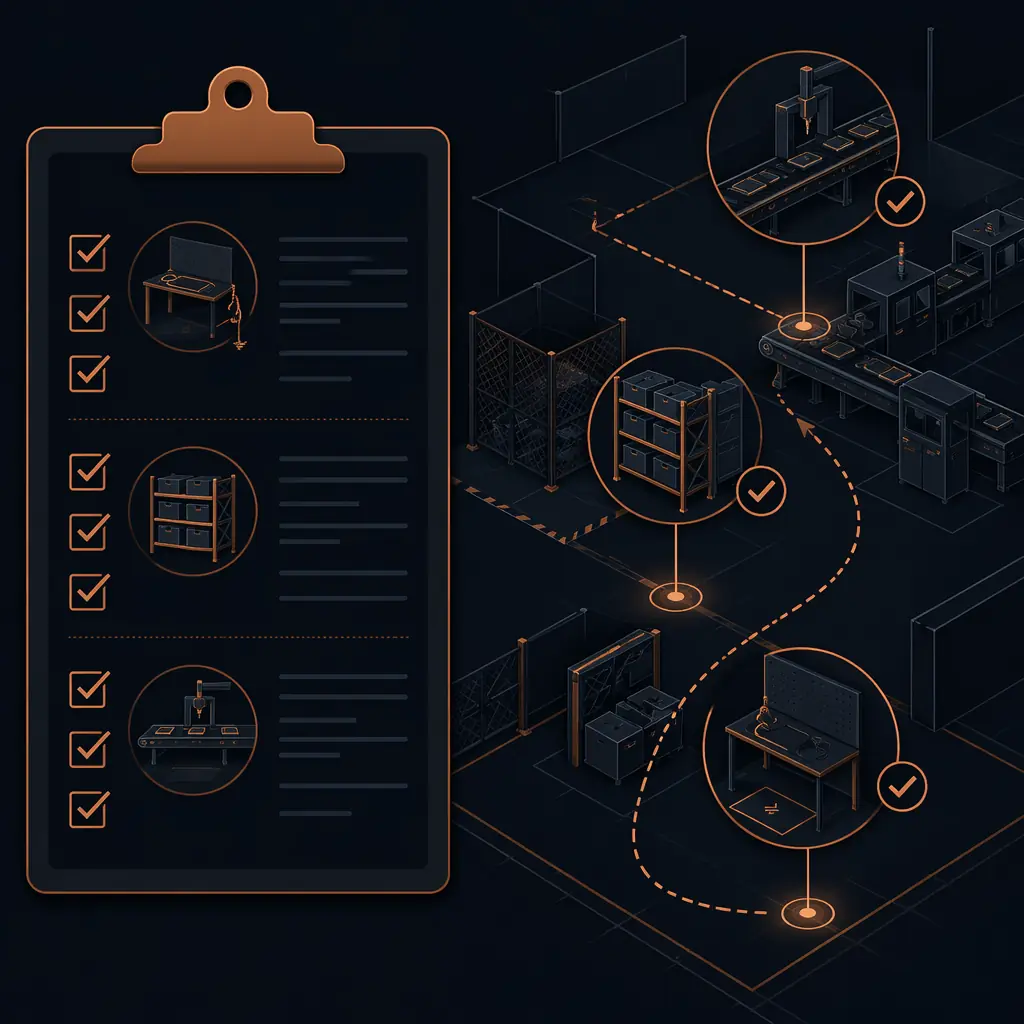
9. The 10-Point Evaluation Checklist
Score each criterion 0–2 points (0 = absent/unsatisfactory, 1 = partial/borderline, 2 = present/satisfactory). Total possible: 20 points.
| # | Criterion | What to Verify | Score (0–2) |
|---|---|---|---|
| 1 | Certifications match product requirements | ISO 9001 minimum; ISO 13485/IATF 16949 if applicable; IPC-A-610 Class level | |
| 2 | Equipment supports your design specs | Pick-and-place machine model/year; 0201 and fine-pitch BGA capability; zone count on reflow | |
| 3 | Inline AOI + X-ray inspection | AOI positioned post-reflow inline; X-ray for BGA/QFN/LGA packages | |
| 4 | DFM review included in quoting | Marked-up design review report delivered with quote; not an add-on service | |
| 5 | Authorized distributor relationships | Named top distributors (Digi-Key, Mouser, Arrow, etc.); spend report available | |
| 6 | Counterfeit detection procedure | 40× visual inspection + X-ray comparison + acetone test for ICs above threshold value | |
| 7 | SPC on critical processes | SPI on paste print; reflow profile data; placement accuracy on fine-pitch | |
| 8 | Board-level traceability | Component reel to board serial number tracking; not just date-code batch traceability | |
| 9 | Volume flexibility | Prototype to mid-volume under one roof; no minimum order quantity penalty | |
| 10 | English engineering communication | Direct technical discussion with process engineer without translator dependency |
Interpreting Your Score
16–20 points: Strong candidate — proceed to site visit or pilot order.
12–15 points: Acceptable with gaps — address the 0-point items before committing to production volumes.
8–11 points: Significant risk — only proceed if price is the overriding factor and you're willing to manage quality issues hands-on.
Below 8 points: Walk away. The cost of quality failures will exceed any price advantage within the first 2–3 production runs.
10. Red Flags That Should Make You Walk Away
Red Flag #1: No Factory Address on the Website
A trading company that buys assembly services from a factory and resells them to you. You're paying a margin for zero value-add, and you have no direct relationship with the factory that actually builds your boards. Legitimate manufacturers are proud of their facilities and show them.
Red Flag #2: "We Can Do Everything" Without Asking About Your Design
Every manufacturer has process limits. A credible manufacturer will ask about your smallest component, finest-pitch IC, board dimensions, layer count, and expected volume — and will tell you honestly if any of these are outside their capability window. A manufacturer who says "yes" to everything before seeing your Gerber files is either desperate or dishonest.
Red Flag #3: No Quality Data Available
If the manufacturer cannot produce a first-pass yield report, defect pareto, or SPC chart for an existing client program — even with the client name redacted — they are not managing quality systematically. They're inspecting and shipping, which is reactive, not preventive. The first quality problem on your program will be the first time they've had to think about root cause analysis.
Red Flag #4: Price 30%+ Below the Next-Lowest Quote
PCB assembly is a mature, competitive industry. The cost structure — equipment depreciation, labor, overhead, component cost — has known floors. A quote that's dramatically below market is cutting something: either using unauthorized component sources (counterfeit risk), skipping inspection steps (quality risk), or low-balling to win the first order with plans to raise pricing later. None of these outcomes benefit you.
Red Flag #5: Refuses to Share Certification Audit Reports
The certificate says they passed. The audit report says how well they passed. A manufacturer who won't share their audit report is hiding the non-conformance list — which every manufacturer has. Transparency about process gaps and how they're addressed is a stronger signal than a clean certificate with hidden problems.
Making the Final Decision: Price Should Come Last
The procurement instinct is to sort quotes by unit price and start negotiating from the bottom. In PCB assembly, that instinct is expensive. The difference between a $12.00/board quote and a $13.50/board quote — $1.50 per board, or $7,500 on a 5,000-unit annual program — disappears the first time you have a quality escape that requires rework on 200 boards, a field failure investigation, or an air-freight expedite because a production run shipped late.
Price should be the last filter, not the first. Start with the 10-point checklist. Eliminate manufacturers below 8 points — regardless of price. Visit the top-scoring candidates or run a pilot order of 50–100 boards with full inspection data. Evaluate the experience — not just the boards, but the communication, the DFM feedback, the quality reporting — and only then negotiate price with the shortlist of qualified suppliers.
Uppcba's international clients consistently tell us that the procurement model they choose — turnkey vs consigned — and the partner evaluation process they follow matter far more to program success than the quoted assembly rate. The right partner at $13.50/board delivers lower total cost than the wrong partner at $12.00/board, every single time.